
Zoho turned Zoho Analytics into an agentic analytics platform. Ask Zia now runs six AI agents that analyse data, build dashboards, prepare data, write formulas, write SQL and train machine learning models from plain-language requests.
Pricing is unchanged, and every plan now includes monthly Zoho LLM credits.
Picture a Monday morning sales meeting. Your manager asks why revenue dropped in one region last month.
Usually someone exports data from the CRM, copies invoices from accounting, cleans it all in a spreadsheet and comes back two days later with a chart.
With the new Zoho Analytics, you type the question and get the answer, the reason behind it and a suggested next step, in minutes.
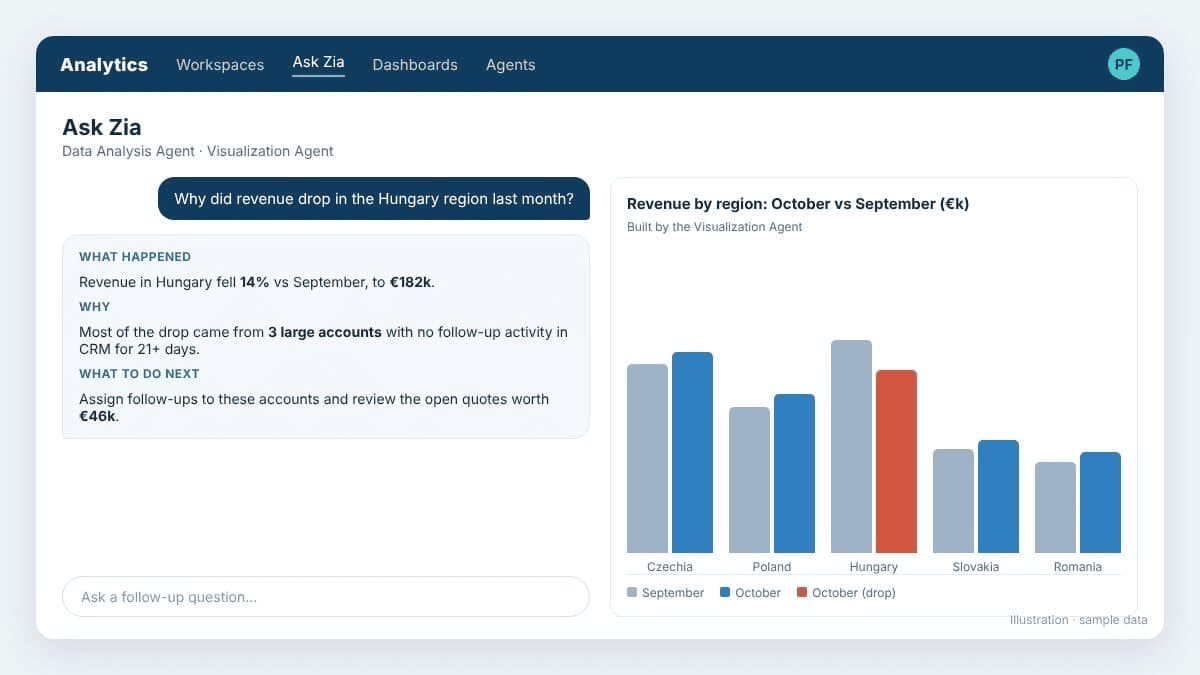
That is the promise of agentic analytics: AI agents do much of the reporting work your team does by hand today. In this guide, the PFC Group team explains what changed, which features matter most for small and mid-size businesses, and how to get ready.
What changed in Zoho Analytics?
Until now, Zoho Analytics was a self-service business intelligence (BI) tool. You connected data and built reports and dashboards yourself.
The new version adds an AI layer on top. Instead of building every report manually, you describe what you need and AI agents do the work. The reports, dashboards and data pipelines they create stay visible and editable, so your team stays in control.
The main changes in one view:
Area | What's new |
AI agents | Six built-in agents inside Ask Zia, plus custom agents |
Business context | Native ontology, semantic layer and scoping |
Data sources | 30+ new connectors, on top of 500+ existing ones |
Advanced analytics | Scenario analysis, better forecasting, anomaly detection |
Reporting | Pixel-perfect reports, custom visuals, 50+ dashboard themes |
Openness | MCP server, CLI, Claude connector, embedded AI |
Governance | Data catalog, data policies, sandbox, AI observability |
The six AI agents in Ask Zia
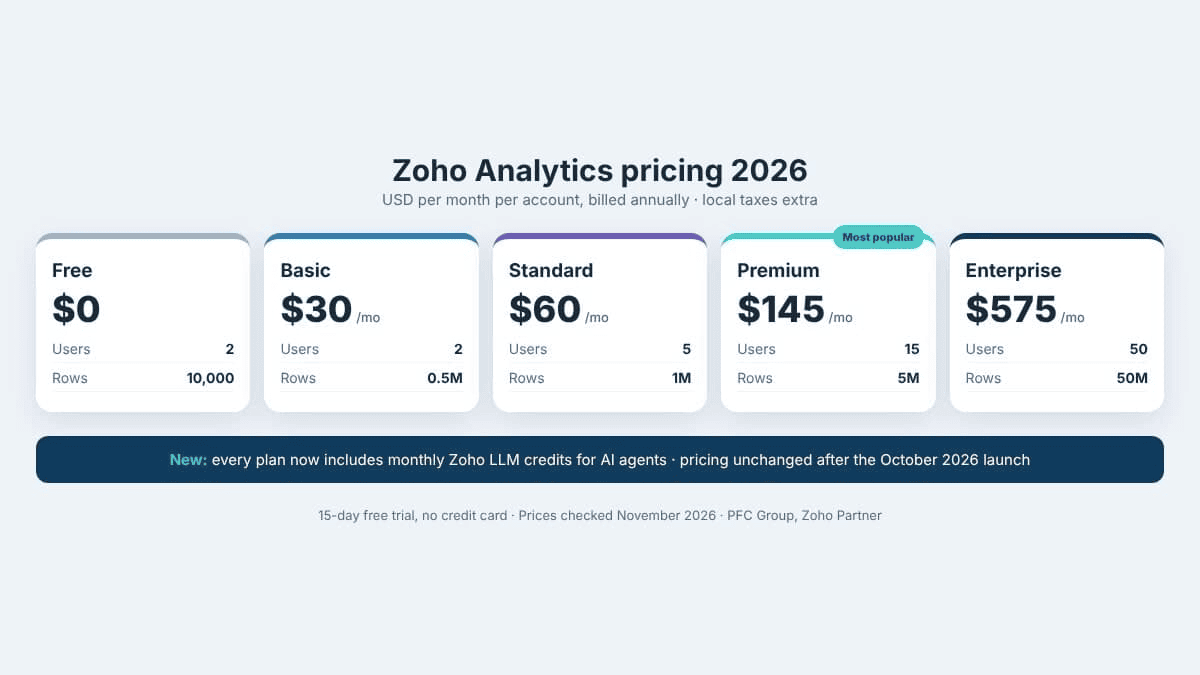
Ask Zia is now a "super agent" that hands each task to the right specialist. All six share the same business definitions and conversation history, so you can move from one task to another without starting over.
Agent | What it does for you | Who benefits most |
Data Analysis Agent | Answers questions in plain language and explains what happened, why, and what to do next | Managers and business owners |
Visualization Agent | Builds charts and dashboards from a description, such as "monthly sales by region vs last year" | Sales and marketing teams |
Data Preparation Agent | Cleans, joins and transforms messy data and builds data pipelines you can schedule | Operations and finance |
Formula Agent | Turns a metric like gross margin or churn rate into a reusable formula | Finance and management |
SQL Agent | Writes, explains, fixes and speeds up SQL queries | Analysts and non-technical users |
DSML Coding Agent | Trains forecasting, classification and other ML models in Python | Data scientists |
Zia remembers earlier questions, so follow-ups work like a normal conversation. You can run it on Zoho's own LLM, on supported external models such as OpenAI, or with your own API key.
Why business context matters for AI
AI only gives good answers if it understands your business. Zoho Analytics now builds that understanding in, with no separate data warehouse needed:
Ontology: maps how customers, orders, products and suppliers connect, for example linking a Zoho CRM contact to the same customer in Zoho Books and Zoho Desk.
Semantic layer: define "revenue" or "active customer" once, and every agent and report uses the same definition.
Scoping: limits an agent to specific data, such as one region's sales.
Setting up these definitions is a one-time job, and it is where most companies need a partner's help.
Other new features worth knowing
Custom AI agents: build agents that follow your own data and rules, or start from ready-made ones, with guardrails on who can use them.
30+ new connectors: including Zoho ERP, SAP, PayPal, Notion and Intercom, on top of 500+ existing ones.
Advanced analytics: "what if" scenario analysis, better forecasting and automatic alerts for unusual spikes or drops.
Better reports: pixel-perfect reports, custom visuals and 50+ dashboard themes.
Open platform: an MCP server, a Claude connector and embedded AI for your own apps and client portals.
Governance: a data catalog, row-level data policies and AI observability that shows which agents ran and what data they used, which also helps with GDPR.
Zoho Analytics pricing and availability in 2026
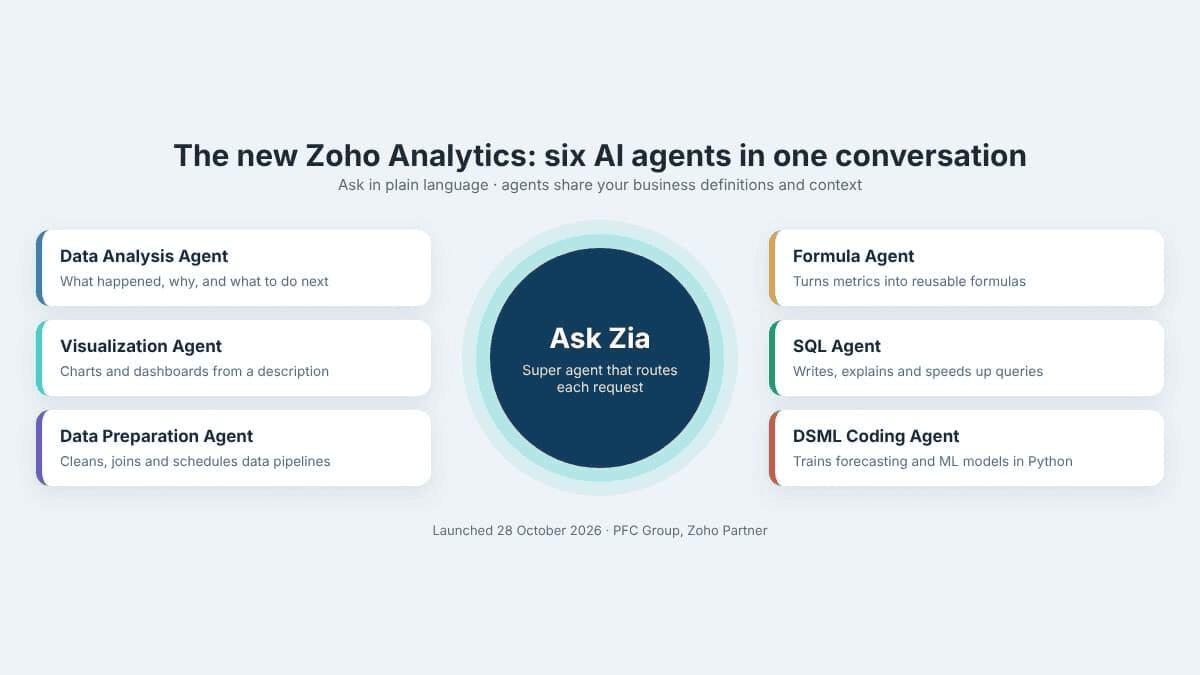
Zoho has kept Zoho Analytics pricing unchanged. Every plan now includes monthly Zoho LLM credits for the AI features, plus a one-time credit pool for leading external AI models. Extra credits are available as add-ons.
Plan | Price (USD per month, billed annually) | Users | Data rows |
Free | $0 | 2 | 10,000 |
Basic | $30 | 2 | 0.5 million |
Standard | $60 | 5 | 1 million |
Premium | $145 | 15 | 5 million |
Enterprise | $575 | 50 | 50 million |
The Basic plan now includes 10,000 Zoho LLM credits per month. Zoho Analytics is priced per account, not per user, and you can try paid plans free for 15 days without a credit card.
Availability: the new features are live in the cloud and rolling out gradually by region.
Need an exact price for your business? Prices vary by region, users and data volume. Book a short consultation with PFC Group and we’ll recommend the right plan and send you a clear quote.
Pixel-perfect reports, the ontology and the semantic model arrive as previews over the next four to eight weeks. The on-premise version gets the update in Q1 2027.
How PFC Group helps you get value from the new Zoho Analytics
The AI agents are powerful, but they depend on clean, connected data and clear business definitions. That is exactly where an implementation partner saves time.
As a Zoho Premium Partner with offices in the Czech Republic, Slovakia, Poland, Hungary, Romania and India, PFC Group helps you:
Connect your data: Zoho CRM, Zoho Books, Zoho Desk and non-Zoho systems such as SAP or local accounting software.
Define your metrics: set up the semantic layer so revenue, margin and "active customer" mean the same thing in every report.
Build dashboards that people use: sales, finance and management dashboards designed around real decisions.
Set up AI agents safely: with the right data access rules, scoping and governance.
Train your team: in your language, so everyone can ask Zia the right questions.
If you already use Zoho CRM, adding Zoho Analytics is often the fastest way to see where your sales really come from.
Frequently asked questions about the new Zoho Analytics
What is agentic analytics in Zoho Analytics?
Agentic analytics means AI agents do much of the analysis work for you. In Zoho Analytics, you describe what you need in plain language, and agents analyse data, build dashboards, prepare data and write formulas or SQL.
Did Zoho Analytics pricing change?
No. Prices stay the same, starting at $30 per month for the Basic plan billed annually. Every plan now also includes monthly Zoho LLM credits for the AI features.
Does Zoho Analytics work with Zoho CRM?
Yes. Zoho CRM data syncs into Zoho Analytics, and the new ontology links CRM contacts with the same customers in Zoho Books and Zoho Desk for a complete customer view.
Is my data safe with Zoho Analytics AI agents?
Admins control which data each agent can access, who can use it and how it behaves. AI Observability shows every agent run, and AI Settings shows what is shared with external AI providers.
Ready to try agentic analytics?
The new Zoho Analytics can turn hours of manual reporting into a quick conversation. The best results come when your data is connected and your metrics are clearly defined.
Talk to PFC Group's Zoho experts. We'll show you a live demo with your own data and plan the right setup for your business.
Book a free Zoho Analytics consultation ·
PFC Group | Zoho Premium Partner. Your partner for Zoho consulting and business automation.